Dyer maker


posted by Ed Park @ 11:35 PM
0 comments

A diary with vertigo

I. Levi Stahl on "the minor T.E. Lawrence":
After the [translation of] Odyssey, Lawrence put in good order a compilation of poems he had liked over the years: Minorities, consisting, with his typical taste for paradox, of minor works by major poets, or major work by minor poets.
"Oh, call us a passage from a modern novel," suggested Colville, "if you're in the romantic mood. One of Mr. James's."
"Don't you think we ought to be rather more of the great world for that? I hardly feel up to Mr. James. I should have said Howells. Only nothing happens in that case!"
5. In Bookforum, Geoff Dyer considers Thomas Bernhard’s My Prizes: “[W]hat a great idea, to offer slivers of autobiography in the guise of self-deprecating moan-boasts about all the honor-insults heaped on one’s head! So much so that one wonders, while reading these outbursts, if it’s not the well-established forms of literary expression—big novels with vast roll calls of characters, enacting the big themes of life and fate, war and peace—but the minor ones, forms that are not even recognized as such, that offer the most challenging test of literary genius.” [BF Sept/Oct/Nov 2010]
Minor applies to form. (Caples mentions the novelist Edgar Saltus, who wrote a 40-pager entitled Oscar Wilde, An Idler’s Impressions—“a puffed-out account of a man he only met twice.”)[22]
6. Minor or major? B.R. Myers begins his scorched-earth Atlantic review of Jonathan Franzen’s Freedom like this: “One opens a new novel and is promptly introduced to some dull minor characters. Tiring of them, one skims ahead to meet the leads, only to realize: those minor characters are the leads.”
9. In Hungary in the 10th century: “People saw bright spherical objects shining like stars, along with a bright torch, moving to and fro in the sky.”
9.[sic] This is a notebook, a minor form. But some of my favorite books are notebooks, diaries, correspondence, collections of columns and reviews. The Nabokov-Wilson Letters. The Weight of the World. Psychotic Reactions and Carburetor Dung. Literature that doesn’t realize it's literature.
12. Most writers live under no illusion of being major. Or is that just me? Even writers whose books invariably land on the bestseller list must know how few _______.
13. One of the appeals of the minor is that we are even reading it—that gives one hope for our own _______.
Labels: B.R. Myers, Garrett Caples, Geoff Dyer, Jonathan Franzen, Levi Stahl, Peter Handke, Thomas Bernhard, UFOs, William Dean Howells
posted by Ed Park @ 9:41 AM
2 comments
D’Harcourt may have wooed her with his favorite topic, his unpublished novel entitled Ro Dran and the Year 90,000. He described it this way: “It is an erotic story of love. It is greater in its imaginative quality than The Arabian Nights. It is the most fantastic, most imaginative, most swiftly moving, most romantic story ever written.” D’Harcourt believed, like generations of frustrated writers both before and after his odd lifetime, that a novel could save him.
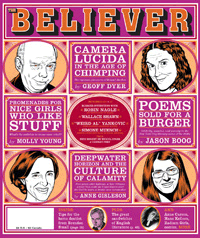
Labels: Ben Folds, Damion Searls, Geoff Dyer, Hans Keilson, Jason Boog, MAgic Molly, Nick Hornby, The Believer
posted by Ed Park @ 12:18 PM
2 comments
I.
While pedestrians speculated on Ms. Lee's activities in the trailer, John Starks, a former shooting guard for the Knicks, posed for photos in a polo shirt adorned with the Starkist logo. "I grew up mixing tuna with mustard and tapping a little sugar into it," he told the Transom. "I always had a sweet tooth. I like tuna melts, too. It helps with the brain and the eyes." —Molly Young, NYO
III.
And so my life fell into the unvarying routine I crave and need. I would wake up, have my muesli at home, work for a bit and then go to Delectica for my elevenses. I said "unvarying" but gradually, as my eagerness to go to Delectica increased, I found it impossible to concentrate on my work because all I could think about was my doughnut and coffee, and so I started having my elevenses earlier and earlier until I ended up skipping breakfast and having my elevenses at nine. At the latest.
I went to bed at night looking forward to my nineses and then, as soon as I woke up, I stumbled out of bed, dressed and went to Delectica before I was even properly awake. Although I loved them and should have savoured them, I started gobbling my doughnut and drinking my coffee in a hurry, gobbling and slurping them down in such a frenzy that I barely tasted a thing. Before I knew it the high point of my day was over with. It was only 8.45am and there was nothing to look forward to. I also found it increasingly difficult to keep my rapture to myself.
One morning, as I gobbled my doughnut and slurped my coffee, thinking to myself, "What a fantastic doughnut, what an amazing coffee," I realised that I had not just thought this but was actually saying aloud, "What a fantastic doughnut! What a totally fantastic experience!", and that this was attracting the attention of the other customers, one of whom turned to me and said, "You like the doughnuts, huh?" —Geoff Dyer, Guardian
Labels: doughnuts, Geoff Dyer, MAgic Molly
posted by Ed Park @ 10:12 AM
2 comments
At the Poetry Foundation, Geoff Dyer traces some interesting artistic-novelistic-poetic connections...Selfdivider on Korea and German literature: "But in [my uncle's] private study, which was only a dark, tiny room with a low sit-down table, he had shelves of books with names that seemed almost mythical to me. Fichte, Hegel, Nietzsche, et al."...Halterius views a rarely seen "disasterpiece," the video-theater version of Merrill's The Changing Light at Sandover...Levi argues that the novels of Richard Stark (Donald E. Westlake) are about work...leading me to dust off this nugget from the Parkives:
GOD SAVE THE MARK
By Donald E. Westlake
Forge/Otto Penzler Presents, 268 pp., $14.95
Fred Fitch, the gullible narrator of Westlake's 1967 novel, receives 300 grand from an uncle he's never met—and then his problems really begin. Sniped at, seduced, and ceaselessly solicited, Fred wises up just enough to keep his life, not to mention his loot. A neighbor fishes for some Fitch funding to self-publish his neglected masterpiece, Veni Vidi Vici Through Air Power, a book that asks one burning question: What if Julius Caesar had had access to a couple of biplanes? Fred himself recalls—or foreshadows—Charles Portis's Dog of the South übernebbish, Ray Midge, prone as he is to wonderfully absurd digressions that you can't help but read aloud: "I wanted to call him Ralph, I really wanted to call him Ralph. I wanted to start my answer with Ralph and end my answer with Ralph and put Ralphs in here and there in the middle of the answer, and answer only in words which were anagrams of Ralph." E.P.
—June 29, 2004, PTSNBN
Labels: Donald E. Westlake, Geoff Dyer, Levi Stahl, Poetry Foundation, Selfdivider
posted by Ed Park @ 8:41 AM
2 comments