Tuesday, December 20, 2011

Late 2011 gleanings


Three books from friends—Victoria Nelson's story collection A Bestiary of My Heart, Jaime Clarke's Conversations With Jonathan Lethem, and Damion Searls's translation of Proust on Ruskin.

Here's D.S. talking about P&R:


Labels: , , ,

Thursday, June 02, 2011

Disambiguations™ for June 2, 2011

Some catch-up...

I. Rachel Aviv made her amazing New Yorker (!) debut last week with "God Knows Where I Am," about a psychiatric patient who refused treatment, moved into the attic of an abandoned house, and subsisted on apples while keeping an extensive diary. Such a good piece. You need to subscribe to read it (though the abstract is oddly compelling).*

II. Hans Keilson, who found late-career American literary success last year (at the age of 101), has passed away. Damion Searls, who translated Keilson's Comedy in a Minor Key, wrote this appreciation/profile of him last year for The Believer, which you can read now in full online.

III. Speaking of The Believer—the June issue is out! Robert Ito kicks it off with a fascinating piece on Josiah Flynt Willard—hobo, writer, turncoat. Charity Vogel finds the godfather of the game show; Hillary Chute (!) interviews Joe Sacco, the war reporter/graphic narrativist; Brandon Stosuy listens to Destroyer's Kaputt; the usual columns including the new Daniel Handler one; and much more...


______
*A side effect of reading Rachel's piece was wanting more, which meant reading some of the rest of the magazine. Great magazine! I liked the profile of Cory Arcangel—excellent. As if a quote from Ed Halter wasn't enough, it also mentions that he was a star lacrosse player at my alma mater. Then I started reading the açai berry piece and a review of a bio of Rabindranath Tagore. But then I had to leave the magazine (it was my sister's).

Labels: , , , , , ,

Friday, February 11, 2011

Addendum to the end of Astral Weeks

Maybe it was always that way. Maybe there was always a vast and strange alienation between an era and the great art which arises in it. Maybe works of art were always as solitary as they are today, and maybe fame was never anything but the distillation of all the misunderstandings that gather around a new name. There is no reason to believe that it was ever any different. For what distinguishes works of art from everything else is the fact that they are, as it were, of the future: things whose time has not yet come. The future they come from is far away; they belong to that final century with which the great circle of paths and developments will be completed; they are the perfected things, the contemporaries of the God that people have been constructing since the beginning and have not come anywhere near completing. If it nevertheless seems as though the great art objects of bygone eras stood in the middle of the surging current of their times, the explanation is that this final, wonderful future, the true home of works of art, was closer to remote times (of which we know so little) than it is to us. Back then, even tomorrow's dawn was part of the distant and unknown that lay behind every grave, and images of God were boundary stones marking the edge of a kingdom of deep fulfillments. Slowly this future distanced itself from us. Belief and superstition drove it away to greater and greater distances, love and doubt hurled it out past the stars into the heavens. And now we have reached a point when our lights let us see far; our instruments reach past tomorrow and the day after that; with our researches we extract the coming centuries out of the future and turn them into a sort of not yet begun present. Science has unrolled itself like a long, unforeseeable path, and difficult, painful developments, of both individuals and the masses, have filled in the coming millenniums with an unending task and duty.
And far, far behind all that lies the home of works of art, these strangely silent and patient things that stand around in all their otherness among the things we use every day, among all the busy people, the beasts of burden, the playing children.
—Rilke, in The Inner Sky (transl. Damion Searls)

Labels: , ,

Thursday, November 11, 2010

Damion Searls, people!

I. Yesterday, read, in one sitting (!), a Polish novel from the 1960s.

II. Damion Searls—a true man of letters!—lists his ten favorite New York Review Books titles, at Conversational Reading. A taste:

The Adventures and Misadventures of Maqroll, by Álvaro Mutis, tr. Edith Grossman

It is impossible to describe this book and how good it is, especially the first three or four of the seven novellas it contains. It’s about a philosophical drifter and his adventures of life and sex and thought and the poetry in our souls that can never be written. Gabriel García Márquez calls Mutis “one of the greatest writers of our time”—Gabriel García Márquez, people!

III. Speaking of which, I recently read some of a GGM novel from the ’70s. HE IS GOOD, let us not forget it; so is Faulkner! So is Joyce!

Labels: , , ,

Wednesday, September 01, 2010

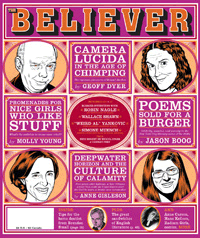
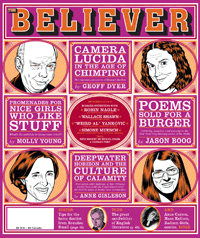
New "Believer"


I. September Believer is out! The one and only Magic Molly (aka Molly Young) on the world of immersive retail; Geoff Dyer (!!? wow!) on Roland Barthes; Damion Searls, translator of Hans Keilson, the centenarian "genius" (F. Prose, NYTBR), on the writer's work—and how his interest in H.K. began with a mistake any bookstore wanderer can identify with ("Ingeborg Bachmann’s perfect autobiographical story ‘Youth in an Austrian Town’ mentions a movie, Romance in a Minor Key, and I misremembered the title, thinking that this book, Comedy in a Minor Key, by Hans Keilson, was it”); Jason Boog with a fascinating look at the epitome of N.Y. bohemia in the ’30s, the Raven Poetry Circle—check out this tantalizing bit:

D’Harcourt may have wooed her with his favorite topic, his unpublished novel entitled Ro Dran and the Year 90,000. He described it this way: “It is an erotic story of love. It is greater in its imaginative quality than The Arabian Nights. It is the most fantastic, most imaginative, most swiftly moving, most romantic story ever written.” D’Harcourt believed, like generations of frustrated writers both before and after his odd lifetime, that a novel could save him.

—plus your Hornby/Pendarvis/Marcus columns, reviews, a Weird Al Yankovic interview (!), some poems, a report from the Gulf, sandwiches in literature...and more...


II.

Speaking of Nick Hornby—why am I just learning about this collaboration with Ben Folds? (Which also includes Pomplamoose?!) And how great is it that N.H. is wearing a Believer T-shirt?? (A: Very!)

Labels: , , , , , , ,

Sunday, August 08, 2010

Who is Hans Keilson?

In today's NYT Book Review, Francine Prose comes right out and says it:

For busy, harried or distractible readers who have the time and energy only to skim the opening paragraph of a review, I’ll say this as quickly and clearly as possible: “The Death of the Adversary” and “Comedy in a Minor Key” are masterpieces, and Hans Keilson is a genius.

And the SF Chronicle talks to the translator of Comedy, Damion Searls...whose fascinating piece on Keilson's life and work will appear in the next issue (Sept.) of The Believer. Stay tuned!

Labels: , ,

Monday, April 19, 2010

Believer notes — update!

V. This week, worlds collide, as Believer writers take the Significant Objects challenge and imbue random objects with enormous meaning for eBay hijinks/charity.

First up is Damion Searls (translator extraordinaire, author of the superb collection What We Were Doing and Where We Were Going, editor of Thoreau's journals, president of the United States) on a Bubblebath Teapot. Coming up: Justin Taylor, Trinie Dalton, Miranda Mellis, and...Heidi Julavits!

(My Significant Objectifying last year: this attractive cow vase.)

Labels: , , , ,

Tuesday, November 17, 2009

More PSB coverage: Madness!


(Time to update that Damion Searls blurb?)

(From D. Lim)

Labels: , , ,

Tuesday, September 01, 2009

September Believer


The September Believer is out, with Rich Cohen on car salesmen, an interview with Rebecca Solnit, Damion Searls's take on the abridged Moby Dick; an amazing excerpt from Stephen Elliott's The Adderall Diaries, Jack Pendarvis's new column, and more (Nick Cave...Brad Neely...). I'm especially excited by Sara Gran and Megan Abbott's piece on V.C. Andrews:

You could argue that Andrews’s books are so unusual and original that critics, scholars, and other “serious” readers don’t know what to do with them. Though there’s an obvious debt to the Brontë sisters, nineteenth-century sensation novels like Lady Audley’s Secret, and Daphne du Maurier’s Gothic fiction, at heart Andrews’s novels have little in common with the genres where they ought to fit. They’re too offbeat for romance, too slow to qualify as thrillers, too explicit for Gothic, and far too dark and complex for young adult. Many booksellers shelve them with horror, but Andrews’s concerns with family, emotion, and relationships put her books firmly outside the genre. Although the supernatural makes brief appearances in Andrews’s work, her largest topic is the all-too-natural tragedy of families gone wrong.

Ultimately, Andrews’s novels constitute their own genre, in which secrets, lies, desire, and moral corruption all stem from—and are contained in—the family. In her world, parents starve their children, sister and brother become husband and wife, and grandparents punish grandchildren for being “devil’s spawn.” No one is to be trusted, and few adults are who they claim to be. Most significantly, there are no happy endings. For all their teen-girl fantasy elements, the books are also gritty, raw, and extremely dirty. There is little cynical or formulaic about them. If anything, they are too raw, too revealing of the author’s own obsessions—which, as we’ll see, might be exactly why no one ever talks about them.


(You must buy the magazine for the whole article...it's worth it™.)

Labels: , , , , , , , , , , ,


View My Stats