Friday, September 09, 2011

Lyrics matter

More great comments on Hey Dullblog—on favorite unreleased tracks, Seinfeld and nothingness, and the theory that "Yesterday" and "The Night Before" are thematically identical—from Devin, Nancy, Glavin (Garvin? Gavin? Garmin? Glaven), and Mr. Levi Stahl. A smattering:

Devin: "Seinfeld": it was fatuous and lazy for commentators to use that phrase "show about nothing" as if it spoke the whole truth. But I think it was legitimately used by some to encapsulate the show's peculiar and innovative charm -- that unlike "The Brady Bunch," say (which like all children of the '70s I LOVE), episodes didn't require a moral or even a resolution. The "something" we'd all been spoonfed (by shows like "The Brady Bunch," which did I mention I LOVE) was the real nothing: bourgeois values and stale homily. (LOVE.) Whereas "Seinfeld"'s "nothing" was really "something"--the vigor, absurdity, and random magic of ordinary life, heightened and tweaked to perfection.

Glaven: As for "Yes It Is" ... Formally, it's a lot like "This Boy", in that the chord progression of e verses is exactly the same as TB, just transposed from the key of D to E; also, the rhythm guitar strumming pattern is exactly the same. This suggests that it may have started out as a rewrite of TB, but I agree with you that it is far superior to the earlier song, and, taken all-in-all, is a far different and far richer song. And Ithink the only way one could conclude otherwise, could see it as a mere knockoff of TB, is by ignoring the far superior lyrics. Lyrics matter. Sometimes I think people forget that.

Nancy: My favorite unreleased Beatles track is Lennon's "Child of Nature." I read somewhere that it was left off the White album because it was too close in subject to "Mother Nature's Son," but I think these two songs would have made a great double A-side.

Labels: , ,

Wednesday, September 07, 2011

The White Album and other hot messes

Over at Hey Dullblog, the Beatles blog for today's modern listener, Mike asks readers for their favorite unreleased Beatles song. This turned into a skewering of the White Album:

That's my biggest issue with White, how it's totally fashionable and false, just like most Beatle's solo output, and not like what came before. Both it and Let It Be seem like the triumph of each band member's persona over their authentic selves; they are their final refusal to change, when change was what The Beatles did best. Lennon's "honest" and politically aware (in a rockstar way) and intentionally grimy. McCartney's that much more eager to please (which is why his music hall thing gets out of control). Harrison's either wafting away on a cloud or acidly angry. Starr is a good ol' boy who just happened to be born in the North of England...I don't like the White Album anymore than I like The Beatles' cartoon, for the same reasons.

There follows a spirited back and forth with the almighty Dev, who decrees:

It's all a matter of what you hear. If you hear something and love it, you'll find ways to give personal context to the importance it has to you. If you don't like it, you'll find those reasons. What you hear as "the Beatles' final refusal to change" I hear as drama--four individuals joined under the skin, that skin withering and wearing, their unity telepathic even as their verbal communication breaks down, fighting within the skin to work together and push the group to new lands: and all of that without, I believe, any conscious intent. White, in the best Beatle tradition, doesn't intend, it IS. Whereas "Abbey Road" for all its magnificent passages is an acquiescence, an abrogation of conflict for bliss, consequently lacking (overall) in drama and even a little inhuman.

White Album is the first principle and the last. It is Moby-Dick. And you thought you were fed up with the praise before!

("Everyone Knew Her As") Nancy steps in, to smooth some feathers:

There's something spooky about the White Album's tendency to engender intense, often negative feelings, both at the time and now. Much as I love parts of it, I can rarely listen to more than a couple of songs from it at a time.

Devin, I agree with you about the way John's comments ("backing band") color the way we hear this album. Certainly there was plenty of tension and bad feeling, but listen to a song like "Dear Prudence" -- what amazing collaboration, especially between Lennon's melody and McCartney's sublime bassline. The evidence of collaboration and enjoyment in many songs makes the overall effect of the album all the sadder.

A lot of food for thought. Great stuff!

And—sorry, Mike—I fall into the pro-White Album camp...I was utterly thrilled when I listened to it for the first time (long before I read any rock crit); if memory serves, a local radio station played an old "classic" album in its entirety every Friday night, beginning at 11. I taped The Beatles off the radio in its entirety, marveling at whole continents of stuff I'd not heard before. Still thrills me. Still have the tape, for that matter!

Labels: , , , ,

Wednesday, July 07, 2010

Only revolutions

The Chicago Tribune reprints—free of charge!—my Astral Weeks column on Matt Kindt's Revolver. They lopped off mention of Alice Sola Kim's story (understandable, I suppose, since the issue of Asimov's is no longer on the stand)...but they also lopped off the last graf of the Kindt review. It now ends on this rather non-end-y sounding note:

“Revolver,” on the other hand, unfurls at breakneck speed, with an unhinged, almost drunken vigor to the deliberately rough drawings. Though the plot is fairly involved, it never feels claustrophobic. Thanks in part to Kindt's unadorned, noir-inflected writing, Sam's existential dilemma is as exciting as watching him and Jan kick in doors and elude snipers.


Here's the ending as it appeared in the L.A. Times:

As I read "Revolver," I couldn't help thinking of the more famous "Revolver," the Beatles' landmark 1966 album. Devin McKinney's description of it, in "Magic Circles: The Beatles in Dream and History," as a sort of pop schizophrenia, seems not irrelevant to the subject at hand:

"'Revolver' is multicolored music in a black-and-white wrapper, terse pop songs of dream, escape, cynicism, forebodings. … By its exploratory nature an affirmation of life and possibility, a bold and radical advance upon the new horizon, the album was at the same time fourteen kinds of oblivion served on a Top 40 platter: nostalgic about what had been, and paranoid about what it saw coming."

Labels: , , , , ,

Monday, June 21, 2010

Food on the shirt

On his most recent trip to New York, the always dapper Levi Stahl bought a copy of Balzac's Treatise on Elegant Living. Here's a bit from Levi's recent post:

It's a lovely little edition, whose translator, Napoleon Jeffries, acknowledges right off the bat one's immediate objection: that Balzac, as evidenced by the photo below, was no dandy. I think there is food on his shirt!--and that's far from the worst of his sins against fashion in this photo!


As Jeffries explains in his brief but solid introduction:

Even those familiar with Balzac's novels may be initially taken off guard by the notion of that giant presenting himself as an expert on elegance--let alone a self-proclaimed originator of, to use his own coinage, the new science of "elegantology." Even more surprising may be the fact that Balzac considered himself something of a practitioner of the science. He was an odd manifestation of early French dandyism: taking his cues in dress from friends such as Eugene Sue and Lautour-Mezeray (both of whom make appearances in this treatise), Balzac proved to be more of a part-time dandy. The dandy memorialist Captain Gronow provided a particularly amusing assessment of the man's elegance in practice: "The great enchanter was one of the oiliest and commonest looking mortals I ever beheld; being short and corpulent, with a broad florid face, a cascade of double chins, and straight greasy hair . . . [he] dressed in the worst possible taste, wore sparkling jewels on a dirty shirt front, and diamond rings on unwashed fingers."

UPDATE: More Balzac (in Nicholson Baker's letter to John Updike, ca. 1985):

Your complete literary man writes all the time. It wakes him in the morning to write, it exercises him to write, it rests him to write. Writing is to him a visit from a friend, a cup of tea, a game of cards, a walk in the country, a warm bath, an after-dinner nap, a hot Scotch before bed, and the sleep that follows it. Your complete literary chap is a writing animal; and when he dies he leaves a cocoon as large as a haystack, in which every breath he has drawn is recorded in writing.

(“Balzac,” quoted in Richard B. Hovey, John Jay Chapman)


* * *

(OK, this is Ed again.) Speaking of things that should be in block quotes: The passage from Devin McKinney's Magic Circles that ends my LAT review of Matt Kindt's Revolver should be set off from my own words. It's still messed up on the website. Which is to say, this passage is pure McKinney:

"Revolver" is multicolored music in a black-and-white wrapper, terse pop songs of dream, escape, cynicism, forebodings… By its exploratory nature an affirmation of life and possibility, a bold and radical advance upon the new horizon, the album was at the same time fourteen kinds of oblivion served on a Top 40 platter: nostalgic about what had been, and paranoid about what it saw coming.

Labels: , , , ,

Saturday, March 22, 2008

Table-talk of Parkus Grammaticus for March 22-23, 2008

I. Hey Dullblog's Devin appears on the Upper West Side on Tuesday, March 25, to talk about the Beatles in 1968; in the meantime, read his take on the great (?) Beatles movie project that never was.
II. On Style; for Moderns meditates on Elton John's sartorial choices:

The background looks like a stock background on offer at your local overmodernized, ruined-a-good-thing photo booth. It's like Hi Mom! Here's me and my fake visit to Yellowstone! Except it's not me in 1997. It's Elton Freaking John in 1974, hairy chested in some pre-JNCO jeans, with less (head) hair than his contemporary self, and holding his hands as awkwardly as hands have ever been held.

III. A friend has unearthed a blog post (I am not quite clear what the blog is called!) devoted to the iconography of Idiocracy. Here's one for tax season:

Labels: , , , , , ,

Thursday, February 21, 2008

"The hidden is more interesting": Three case studies

1.

[...]The paragraph quoted above is followed directly by a breathtaking instant of self-exposure: “For me,” Marsh writes, “to see this sour Dave Dexter Jr. is to remember the face of my father.”

My marginal note at that point: Marsh comes clean? Could this explain the gouts of contempt he sprays at Dexter’s ghost, the extremity of which have by this late point rendered the book irretrievably unpleasant? Marsh has written elsewhere — in this and other books — about his father, a Rust Belt racist (“angry,” “square,” “rednecked”) who hated rock ‘n’ roll, belittled his son for loving it, and withal was a working-class exemplar of “jaundiced snobbery and proud ignorance.” Now, father-hatred could be a compelling psychological explanation for the anti-Dexter excess. But no. Marsh lets fall the clear implication, refusing to follow up the psychic connection he has himself made and to which the reader is inevitably drawn — if only because its suggestion of the hidden is more interesting than what Marsh has made visible. —Devin McKinney on Dave Marsh, Hey Dullblog


2.
Reich’s preference for the exaggerated, at least in part, led him down the orgonomic path of starry-eyed prophetic cloud-busting. Reich’s story can thus be read as kind of allegory about psychoanalytic thought itself. Reich took up the least appealing parts of Freud and pursued them to their most absurd ends. Our inclination to ridicule Reich every few years becomes a way of conducting proxy skirmishes in the perpetual debate about Freud’s legacy and relevance. When we exaggerate the discontinuity in Reich’s life, casting him in dual mythical roles as Freud’s most promising student and Freud’s most berserk deserter, we seem to be staking out our own ambivalence to Freud’s discomfiting ideas. We incarnate in one person what seems most preposterous about psychoanalysis, and then we place that person at once as close to and as far away from Freud as we can. —Gideon Lewis-Kraus on Wilhelm Reich, Nextbook


3.
I think something curious and heretofore unacknowledged has been taking place, an unconscious disavowal on the part of some viewers and critics—a phenomenon that could make for a chapter in The Discovery of the Art of the Insane. Through misquoting, mishearing, and misreading, people have turned this careful scholar into a veritable Kinbote, a moral scapegoat to whom can be assigned all the darkest theories—as if he were the one who had applied the delicate wash of watercolor blood at the base of a severed head, or imagined the force-feeding of body parts to children. What do we want from John MacGregor? Perhaps this: to saddle him with all our deepest anxieties about the possible actions of Henry Darger, so that the madman-scholar can be rejected with a show of presumptuous indignation. It is the secret expiation required to enjoy Darger without tears. —EP on Henry Darger and John MacGregor, PTSNBNES

Labels: , , , , , ,

Saturday, February 16, 2008

Weekend Table-Talk for February 16-17

I. Dizzies Team Member Devin on Dave Marsh's The Beatles' Second Album (at Hey Dullblog)—ouroboric and brilliant:

Dexter’s Capitol mutations, whatever their lack of propriety, decency, or respect for the art of the Beatles — something not even the Beatles were convinced existed at that early date — are lovable, explosive, crass, and exciting albums. Mutated or not, slick with stereophonic grease or not, they are the essence of pop as commerce and con game, gaud and gift, bang for the buck. But because Marsh so hates Dexter, he must make the case for hating Dexter’s mutations — though this is obviously counterintuitive to him, not least because here he is himself making money writing a book about how great one of those mutations is.


II. The Guardian profiles Mountain Goats' maestro John Darnielle:

Today, he is drinking warm ale and discussing his new record, Heretic Pride. It is, he explains, "a much more fun record than I've made in a long time", full of songs about Prince Far I, cheap motels, religious cults and swamp creatures. "Now, there's real kinship between your monsters and your pulp-fiction figures and your cult leaders and all these two-and-a-half dimensional creatures that you can then invest with all these things that you yourself bring to the table," he says with an exuberant thwack, then launches into a tale of Michael Myers and Sax Rohmer and HP Lovecraft and Michel Houellebecq, and of his days as a "scrawny little fella" when an ingrained iggishness prevented him from watching any slasher movies. "It is," he concludes, "a sort of cataloguing of my old obsessions."


III. Bookcase challenge II:


How many books can you ID? (That's NBCC prez John Freeman and agent Nicole Aragi.)

(From an old Bookforum piece)

IV. Dizzyhead Dennis reports from the Berlin Film Festival. (Um, not for us, oddly enough, but for the NYT.)

Labels: , , ,

Tuesday, February 12, 2008

The Dizz

Over at Hey Dullblog, which wants to be your Beatles site, Dizzies Team Member and HD guiding spirit Devin has a truly hair-raising outtake from his book, Magic Circles.

* * *

Dizzyhead Brian sends us to Nina Katchadourian's Continuum of Cute. Be prepared to lose a half hour instantly.

* * *

Listening to the new Mountain Goats—"Lovecraft in Brooklyn"!

I was trying to think what this reminded me of—then realized that in one of the unpublished Parkian novels, I invented a failed sitcom called Howard and Sonia. (I find this interlude in HPL's life terribly poignant—marriage to a fellow amateur writer, transplant to Brooklyn, searching for work, finding none, retreat.)

Labels: , , , ,

Monday, January 14, 2008

Dizzies Newsfeeds for January 14–15

I. The Stubblemeister on an ancient stereo system! Proust had one!
II. Dizzyhead Jessica on a "supernatural picaresque"! Wow!
III. Team Dizzies recruit Devin on Edmund Wilson! Hello to all that!
IV. The unstoppable Levi: Donald E. Westlake—Anthony Powell fan?!
V. Dizzyhead Ben's top reads of '07...including a little curtain raiser for his Frank Stanford article (appearing soon)...yowsa!
VI. The Crude Futurist on a random wild booksore find: FUP, by Jim Dodge. Keeleresque? Sure, why not...anything to get more people "hooked on HSK"!

Labels: , , , , , ,

Tuesday, November 20, 2007

You're not here

Hot off the wires: Our man Devin on the new Todd Haynes film (in the Guardian):

Maybe the happiest thing to say about I'm Not There is that it is bold enough to be a mess, and self-indulgent enough to embody the worst tendencies of its subject. That is, it's a failure of the kind that Dylan himself is uniquely prone to committing. —"Bob Dylan #12 and 35 (and 47, and 66...)"

Speaking of which—the latest New-York Ghost features an interview with Haynes himself. It's not too late to subscribe!

Labels: , ,

Sunday, November 11, 2007

Kiddie modernist flatland

Who wrote this about Peanuts?

Never sentimental, never ironic, it took place in a kiddie modernist flatland where every gag was deadpan and every day held its little heartbreak, its little revelation.


Bill Watterson in the WSJ? Nicholson Baker in the NYO?


No—Devin McKinney in the Guardian! Here's some more:

Its title was quickly changed to Peanuts by the head of UFS. Apparently Schulz hated it because it didn't mean anything-were the characters the Peanuts or what? No explanation-hence it's the perfect name.

Read it all here.

* * *
In Britain, [Werner Kleeman] was transferred to division headquarters to serve as a post-invasion interpreter, an assignment in which he would forge several lifelong friendships, one of them with a counterintelligence man named Jerry Salinger, who wanted to be a writer.

“Jerry was just a nice little boy then,” Mr. Kleeman said of the man who would become the celebrated J. D. Salinger. “He was kind of quiet.” —NYT


Labels: , , ,

Friday, November 02, 2007

Classic McKinney

In the L.A. City Beat (via MG): "Is it presumptuous to anoint a book only five years old this October a 'contemporary classic'?"

Not when it's Dizzyhead Devin's Magic Circles: The Beatles in Dream and History!

Labels: ,

Thursday, August 30, 2007

I've just seen a banner ad

Sean Lennon: World's most interesting face?

* * *

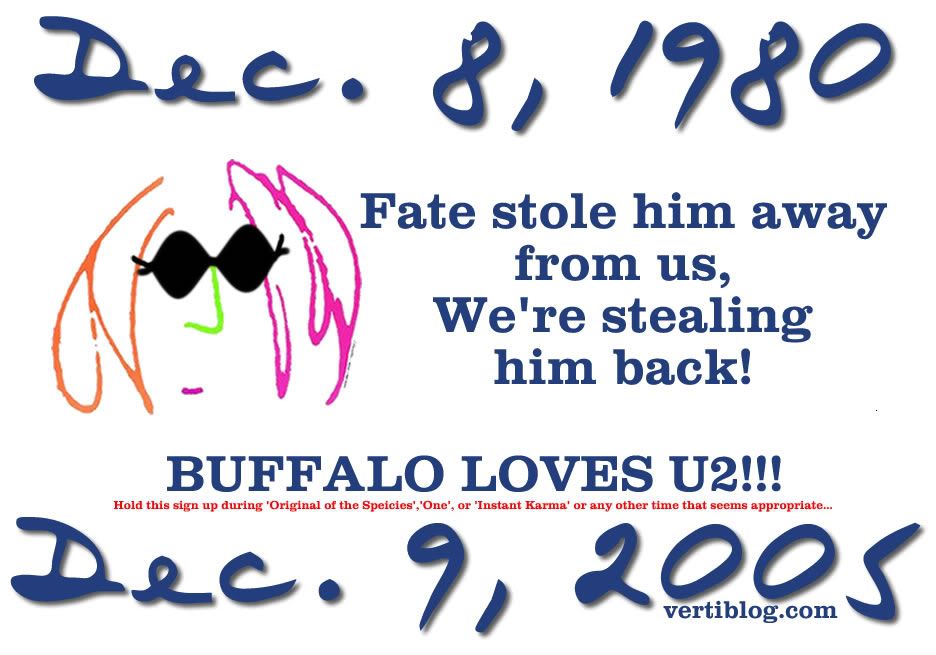
And—I was looking for something else to post here—Dizzyhead Devin's Boston Globe piece on Beatles covers—and wound up at Vertiblog, a U2 site. The flashing banner contains some interesting trivia:

U2 was in Buffalo the night Lennon was shot
U2 will be in Buffalo again on December 9, 2005
The 25th anniversary of Lennon's murder...

(Well, the date's off by a bit, but you get the idea.)

Then you can print out this little graphic/posterette to wave at the concert.

And get into a time-travel machine, as it looks like the blog hasn't been updated in a while...Still, an interesting bit of trivia for Buffalo/Beatles/U2 enthusiasts.

Labels: , , ,

Sunday, July 29, 2007

Domino dancing

1. Memories of Pop With a Shotgun: Fab Four, Howard Stern, David Thomson, and more.

2. Great Onion piece: "Earthquake Sets Japan Back to 2147." Sample line: "The prime minister said that the greatest effort would be exerted on rebuilding the Procross Buster Quasigravitic Lensing Frame, the motive force behind Japan's automated network of roads, aerobuildings, and levitation canals."

3. Nice pic of a jar of rubber cement!

4. Levi weighs in on the ouroboros and more (NSFW!)...

5. Rachel in the Times on a two-person abstinence society at Harvard. The piece contains the classic line: "He redirects his attention toward his fajitas."

(Accidentally double-clicking that last word got me: "A dish consisting of strips of marinated meat, poultry, or vegetables that are grilled over an open fire and served in a tortilla, usually with spicy condiments. Often used in the plural.")

6. This NYT headline today led me to my first iTunes purchase in a while—does anyone remember this?

"April Wine" now appears right before "Arcade Fire" on my iTunes. There's a line in French toward the end of the song; what if all Canadian groups had to include a line in French in every song (or a song entirely in French, à la the Arcade Fire's "Une Année Sans Lumiére," on every album)?

Labels: , , , , ,

Wednesday, July 25, 2007

Walking the cat


Dizzyhead Devin and wife Kathy and feline Nietzsche—avatarized!

Labels: ,

Monday, July 16, 2007

Dizzies Newsfeeds™ for Monday, July 16

Light blogging till at least midweek—?!

1. Dizzyhead John, the brains behind Team Knucklehead and the "Theme From the New-York Ghost," alerts us to a free download of The Format's new album, Dog Problems. Today's the last day!

2. Dizzyhead Devin has posted the text to his talk, "Hotter Than a Crotch," which he delivered at the recent Dylan symposium in Minneapolis (and which was mentioned in Time magazine). Here's how it starts:

In November of 1972, Bob Dylan went to Durango, Mexico to play a small part in Sam Peckinpah’s Western Pat Garrett and Billy the Kid. The production was cursed by all the expected crises, but there was one element on the set that no one saw coming. Peckinpah’s biographer, David Weddle, writes that, “The topsoil of Durango was permeated with animal manure that dried up, blew around with the fine silicone dust, and lodged in people’s lungs, causing chronic pulmonary infections.” One of the film’s stars, James Coburn, said that in Durango, “It was really cold and damp, there was wind, and a thousand years of horseshit floating around in the air.”
3. "TUNING FORK SCREECH PUTS OUT 24-INCH FLAME; FUTURE FIREMEN TO STAY HOME, SAYS SCIENTIST." In other words, Paul Collins rules!

4. Any further thoughts on the Ouroboros? Discussing ouroboric films with Dizzyhead Dennis, it seems that there is some crossover to another favorite motif/symbol/thingy—the Möbius Strip! Dennis asks if Lost Highway counts as one or the other, as it "opens—and ends—with someone saying "Dick Laurent is dead" into an intercom and it turns out the speaker and listener are the same person..."

Jawbone's recent comment reminded me of this nifty review by Angela Starita from the PTSNBN:

But despite a jacket photo of the jowly Manganelli facing down a Pinocchio doll, Centuria is a wonderful read for its endlessly inventive send-ups of narrative conventions. Manganelli's "novels" telescope time so that his characters end where they started, like the ouroborous of the subtitle—an ancient symbol of renewal showing a snake that bites its tail.

UPDATE: From Dizzyhead Stubes, responding to our challenge (as "JMS"):

Perhaps of some small interest, my solution (if it counts as such) to your question #3 was, like your friend Izzy’s, orthographically derived, tho not a misreading. I merely noticed the similarity of the two words (then again, it was late—maybe my eyes were crossing). But I didn’t know the Sante passage, per se. Also interesting that Sante was on the verge of realizing a wonderful… something--not quite sure it qualifies as a pun--when he compared the coil of the outerboroughs to the Ouroboros, but missed his chance. Ah, well…


5. Also via Dennis, from Anna Karina's Sweater, this amazing look at two precursors to "2046" (the room/year of Wong Kar-wai's titular film)—can Dizzyheads think of more?

6. Team Dizzies members are encouraged to post—I'm hoping Sweeney will link to a Buffalo mixtape in the making...?! Singer will interview himself? Izzy will post a picture of the Colonel disemboweling a Michael Pollan book? Hua will do a dance? Arlo will post her avatar? Chrita?

Labels: , , , , , , , ,

Saturday, July 14, 2007

Fangs for the memories

My latest Astral Weeks column is up at the L.A. Times. This month I cover Liz Williams's Detective Inspector Chen novels and David Wellington's fangfest 13 Bullets.

But enough about me: Dizzyhead Hua rhapsodizes over a single LCD Soundsystem song over at Slate, and the Oxford American features two Dizzyhead contributions: Devin McKinney on William Bradford Huie and Andy "Citizen Truth" Selsberg on what it means to eat like a man. (And still seen on the stands recently: The first part of B. Kite's "Rivette-iad," in Cinema Scope.)

Labels: , , , , , ,


View My Stats