Friday, February 06, 2009

February Believer


February Believer is out! It's all over the map. Don't get whiplash! Muriel Spark...New Zealand rock...Thornton Wilder's other writing...Travis Nichols talks to John Ashbery...Sheila Heti talks to Mary Gaitskill...Stephen Burt reviews Robyn Schiff's Revolver...Tom Bissell on videogames...MORE...The very funny Jack Pendarvis, with "The Fifty Greatest Things That Just Popped Into My Head"...Dzyd Khongster's food-centered micro-interviews...

Labels: , , , , , , ,

Tuesday, January 13, 2009

The incredible disappearing post

[This post, "Poetry Roundup™," was supposedly published on 1/7/09, but seems to have disappeared. We are pleased to re-post it.]

I. At the NBCC blog a dizzying interview with poet (and Sebald fan) Robyn Schiff:

Can you speak a bit about the genesis of Revolver and how you conceptualized this book? There are many levels of inventions engaged here: the patented products, such as the sewing machine and the revolver, mainstays now slowly becoming archaic; merchandise such as furniture and silverware that’s inextricably bound to its legendary manufacturers (Taylor & Sons, J.A. Henckels); and then there are those fashion industry icons (Ralph Lauren, Calvin Klein) whose commodities are popularized by more contemporary mythologies of beauty and desire. Each presents a history that spins outward into other compelling human stories. How did you begin to gather all of these different objects and how did you evaluate whether or not they would be compatible in this community of poems?

The question of compatibility is a great way for me to think about my curatorial instinct in Revolver. Initially I set out to write about objects that were on display at the Great Exhibition of 1851— a sort of Victorian world’s fair—and I thought the book would be encyclopedic and touch on absolutely everything in the 1851 illustrated catalogue. The objects on display at the Great Exhibition were not chosen for their compatibility, but rather, the only thing they supposedly had in common with one another was their level of innovation and artfulness. It was an industrial fair, after all, and it was meant to show human progress and in particular British domination. But with just the tiniest bit of scratching at the surface of any of these weird objects, they began to display all sorts of unintended affinities: unfathomable violence, fierce issues of control, a nearly fetishistic interest in portability and adaptability that seemed to be in conversation with colonialism and Western expansion. As I started to discover this, I also began arbitrarily researching items related to 1951. It was no surprise that the vapor trails these newer objects left were as bellicose as the others; they weren’t vapor trails, they were warpaths. That made me a little dizzy. And I started to question my own encyclopedic urge, which was coming to feel really overwhelming, really wrongheaded. In the end, I evaluated what could be in the book based on the physical sensation I had in my body when I started doing the research. I remember, for instance, watching old Calvin Klein commercials on YouTube, and in one a young Brooke Shields is whistling “Oh My Darling, Clementine.” The vertigo of associations I felt fluttering within me, and the sheer empathy I felt with my whole body toward the material made me write the Klein poem; if I don’t have a physical sensation like that I don’t attempt a poem. As a result, I don’t write very often.


II. In the TLS, Ali Smith considers Sylvia Townsend Warner. Best line:

“She had the spiritual digestion of a goat”, according to John Updike

III. At the Poetry Foundation, Ian Daly on Jeffrey Miller:

The two are still in disagreement about the exact day the newest, youngest member of the Russian River scene showed up on their doorstep—“a flinty-eyed poet with spiky blond hair and a wicked smirk,” as Nolan remembers it. But they agree on one thing: there was something special about the 23-year-old Jeffrey who rolled into town alone in the summer of ’75—steeped in Iggy Pop and Ted Berrigan—with a few boxes of belongings, a couple packs of Marlboro reds, and, as Codrescu describes it, “this crazy idea we all had at the time that you could still make a living as a poet.” Before long he was part of the Knotty Room roundtable, bullshitting between drags about the nature of truth and beauty and, probably just as often, the relative merits of various rock bands and the acquisition of illicit substances. He and Codrescu were instant friends, taking long walks and lingering at the local dive bars, where they’d do their best to parlay their poetic condition into rounds of free drinks. My aunt showed up later that year.

IV. And in the pages of the Believer, Travis Nichols reviews the (amazingly titled) Jack Spicer collection, My Vocabulary Did This to Me, and Stephen Burt looks at Jordan Scott's Blert. Here's Geoffrey O'Brien's take on Spicer, at TPF:

But there was much more writing still to emerge—other poems, manifestos, handbills, questionnaires, letters, novels, plays, and the elusive “Vancouver lectures”—which, even in incomplete form, had established themselves as an indispensable text for young poets. (The idea that writing poetry was a matter of taking dictation from unseen Martians seemed to make a good deal more sense than the theories of Allen Tate or Cleanth Brooks.)

V. Someone should write a novel or produce a sitcom in which Philip K. Dick, Jack Spicer, and Robert Duncan are roommates. (TRIVIA: What cult novel—not by PKD—is dedicated to Spicer?) From my L.A. Times review of PKD's Voices From the Street:
But mainstream acceptance was Dick's first novelistic ambition, one that took years to dispel. An early fan of “scientifiction” stories, Dick also read widely outside the genre. In 1940s Berkeley, beginning at age 19, he roomed in a converted warehouse occasionally occupied by literary figures like poets Robert Duncan and Jack Spicer, with whom he struck up friendships. During this time, according to biographer Lawrence Sutin, he was inspired to steep himself in the classics (“I gained a working knowledge of literature from the Anabasis to Ulysses,” Dick wrote in a 1968 “Self-Portrait”), with special attention to modernists like Ezra Pound and John Dos Passos. Sutin notes that from 1951 to 1958, Dick wrote dozens of science-fiction stories and six science-fiction novels, all of which were published, and seven mainstream novels, none of which found a publisher in his lifetime.

Labels: , ,

Monday, January 07, 2008

Poetry Roundup™

I. At the NBCC blog a dizzying interview with poet (and Sebald fan) Robyn Schiff:

Can you speak a bit about the genesis of Revolver and how you conceptualized this book? There are many levels of inventions engaged here: the patented products, such as the sewing machine and the revolver, mainstays now slowly becoming archaic; merchandise such as furniture and silverware that’s inextricably bound to its legendary manufacturers (Taylor & Sons, J.A. Henckels); and then there are those fashion industry icons (Ralph Lauren, Calvin Klein) whose commodities are popularized by more contemporary mythologies of beauty and desire. Each presents a history that spins outward into other compelling human stories. How did you begin to gather all of these different objects and how did you evaluate whether or not they would be compatible in this community of poems?

The question of compatibility is a great way for me to think about my curatorial instinct in Revolver. Initially I set out to write about objects that were on display at the Great Exhibition of 1851— a sort of Victorian world’s fair—and I thought the book would be encyclopedic and touch on absolutely everything in the 1851 illustrated catalogue. The objects on display at the Great Exhibition were not chosen for their compatibility, but rather, the only thing they supposedly had in common with one another was their level of innovation and artfulness. It was an industrial fair, after all, and it was meant to show human progress and in particular British domination. But with just the tiniest bit of scratching at the surface of any of these weird objects, they began to display all sorts of unintended affinities: unfathomable violence, fierce issues of control, a nearly fetishistic interest in portability and adaptability that seemed to be in conversation with colonialism and Western expansion. As I started to discover this, I also began arbitrarily researching items related to 1951. It was no surprise that the vapor trails these newer objects left were as bellicose as the others; they weren’t vapor trails, they were warpaths. That made me a little dizzy. And I started to question my own encyclopedic urge, which was coming to feel really overwhelming, really wrongheaded. In the end, I evaluated what could be in the book based on the physical sensation I had in my body when I started doing the research. I remember, for instance, watching old Calvin Klein commercials on YouTube, and in one a young Brooke Shields is whistling “Oh My Darling, Clementine.” The vertigo of associations I felt fluttering within me, and the sheer empathy I felt with my whole body toward the material made me write the Klein poem; if I don’t have a physical sensation like that I don’t attempt a poem. As a result, I don’t write very often.


II. In The Guardian, Ali Smith considers Sylvia Townsend Warner. Best line:

“She had the spiritual digestion of a goat”, according to John Updike

III. At the Poetry Foundation, Ian Daly on Jeffrey Miller:
The big event in Monte Rio back in the ’70s was the mail. In the morning, Codrescu and Nolan would wander down to the concrete post office to retrieve it and then head over to a greasy spoon called the Knotty Room to go through their letters. One day an envelope of poems showed up in Nolan’s mailbox from someone named Jeffrey Miller, who’d written at the behest of one of his college professors back in Michigan. They’d never seen anything quite like them.

“His poems captured the kind of rock ’n’ roll fervor that infected everything in those days,” Nolan said. “Incredibly hip, witty, sardonic, surreal, and seized with savage energy.” They wrote Jeffrey back with an invitation to come to Monte Rio anytime.

The two are still in disagreement about the exact day the newest, youngest member of the Russian River scene showed up on their doorstep—“a flinty-eyed poet with spiky blond hair and a wicked smirk,” as Nolan remembers it. But they agree on one thing: there was something special about the 23-year-old Jeffrey who rolled into town alone in the summer of ’75—steeped in Iggy Pop and Ted Berrigan—with a few boxes of belongings, a couple packs of Marlboro reds, and, as Codrescu describes it, “this crazy idea we all had at the time that you could still make a living as a poet.” Before long he was part of the Knotty Room roundtable, bullshitting between drags about the nature of truth and beauty and, probably just as often, the relative merits of various rock bands and the acquisition of illicit substances. He and Codrescu were instant friends, taking long walks and lingering at the local dive bars, where they’d do their best to parlay their poetic condition into rounds of free drinks. My aunt showed up later that year.

IV. And in the pages of the Believer, Travis Nichols reviews the (amazingly titled) Jack Spicer collection, My Vocabulary Did This to Me, and Stephen Burt looks at Jordan Scott's Blert. Here's Geoffrey O'Brien's take on Spicer, at TPF:

But there was much more writing still to emerge—other poems, manifestos, handbills, questionnaires, letters, novels, plays, and the elusive “Vancouver lectures”—which, even in incomplete form, had established themselves as an indispensable text for young poets. (The idea that writing poetry was a matter of taking dictation from unseen Martians seemed to make a good deal more sense than the theories of Allen Tate or Cleanth Brooks.)


V. Someone should write a novel or produce a sitcom in which Philip K. Dick, Jack Spicer, and Robert Duncan are roommates. (TRIVIA: What cult novel—not by PKD—is dedicated to Spicer?) From my L.A. Times review of PKD's Voices From the Street:
But mainstream acceptance was Dick's first novelistic ambition, one that took years to dispel. An early fan of “scientifiction” stories, Dick also read widely outside the genre. In 1940s Berkeley, beginning at age 19, he roomed in a converted warehouse occasionally occupied by literary figures like poets Robert Duncan and Jack Spicer, with whom he struck up friendships. During this time, according to biographer Lawrence Sutin, he was inspired to steep himself in the classics (“I gained a working knowledge of literature from the Anabasis to Ulysses,” Dick wrote in a 1968 “Self-Portrait”), with special attention to modernists like Ezra Pound and John Dos Passos. Sutin notes that from 1951 to 1958, Dick wrote dozens of science-fiction stories and six science-fiction novels, all of which were published, and seven mainstream novels, none of which found a publisher in his lifetime.

Labels: , , , , ,

Wednesday, March 07, 2007

The Journalist


I've acquired some new journals over the last few weeks. Here's the rundown:

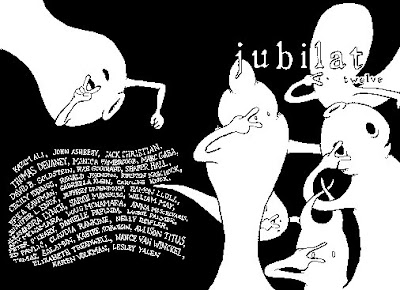
Jubilat Twelve contains facsimile reproductions of the typewritten "X-Lax" poems of Ronald Johnson (one-word poems, in which the word—knit—is manipulated typographically, a whimsical experiment in the limits of meaning; these were done in enigmatic parody of Robert Lax), an essay about the illustrations of Stevie Smith, a few stunning prose excerpts (called "Three Poems"!) by Dizzyhead Sarah, an excerpt from The Book of the Lover and the Beloved by (Borges and Frances Yates fave) Ramon Llull, and much more.

The Canary, #6, co-edited by my friend Nick, has work by Jalal Toufic, Eileen Myles, Ange Mlinko, and more; it's a must for any admirer of Stone Reader, because it features SR subject Dow Mossman's Joycean poetry—fascinating.

A Public Space, No. 3, has a nifty short essay by Dizzyhead Ben, "When Animals Conspire"; an extract from the new Lethem novel; an Anne Carson poem; a Peru portfolio; Nora Krug's five-page graphic feature (what's the right term? "comic-book story"? No.) "Never Give Up! Fukutsu: The Life of Hiro Onoda, Soldier," about a WWII combatant who lived for decades on an island in the Philippines, disbelieving that the war was over; and a terrific poem ("Lustron: America's Prefabricated Home") by Robyn Schiff, which inventively recycles the name (and certain other words: "future") in a manner appropriate to a mass-produced (yet roomy) product:
Lustron has a no-nonsense Westchester model house, which I like to think of as a Winchester Mansion* for a Western destiny already won. See how fast the past lips into the future; it's a matter of a few letters and a notary public to change your/spent cartridge and you're ready to aim again[...]

*I think Winchester Mansion must be a reference to the Winchester Mystery House, which was being built for decades but was never finished.

* * *

Speaking of poems: Check out Cathy Park Hong's "O Light, Red Light," a new sestina (from her upcoming book, which I'm excited about) up at McSweeney's. Look what she does with the sestina form, invigorating it with her meticulous mongrel tongue:

Girls! Girls! Girls! Batted molas eyelashes at boned molish chap,
But lika Greco Frieze, him stood in cold puddle o red light,
Spite One Girl! Curdling she finga, 'Come bwoy, Come, don' G'won.'
Toto sum Girls! curdled dim fingas attim but he maki no choice.
Only browsed 'till sighed 'nut'a day.' Went back, spillim seeds
onto hotel carpet, lone, wit only zuzzing cable, a suite nocturne.

Ai fife, he warbled, Ai la lune triste nocturne.
'E capered down to karaoke lounge to singsong, a sloshing chap,
At hotel, quaffing Singapore Slings wit pomegranate seeds.
Next day, 'E kem back to de Girls! ta fes de garnet light.
Fished outtim haisimap pinga, but brined bine choice
E sterilized, and de Girls! chortled 'G'won home, batty bwoy, g'won.'

* * *

Finally: Jane Dark on Baudrillard.

Labels: , , , , , , , , , , ,


View My Stats